
Strong, Comfortable Homes Built with Wood
Wooden Homes Suited to Japan’s Climate and Environment
In Japan’s hot, humid climate with significant temperature fluctuations, wooden homes are the most suitable form of housing.
While many housing styles around the world use stone or earth, in Japan, homes built with wood—offering natural humidity control, lightness, and structural strength—have gained overwhelming support.
At KAⅡ Design & Work, we fully leverage the unique characteristics of wood to create apartments that are safe, secure, and built for long-term durability.
Wood is, in fact, more fire-resistant than steel, and when kept dry, it retains its strength over extended periods—making it an ideal construction material.
We invite you to explore the many advantages of wooden construction and the thoughtful details behind our approach.
Wood Is Actually More Fire-Resistant Than Steel
Wood is often considered vulnerable to fire because it can be used as fuel.
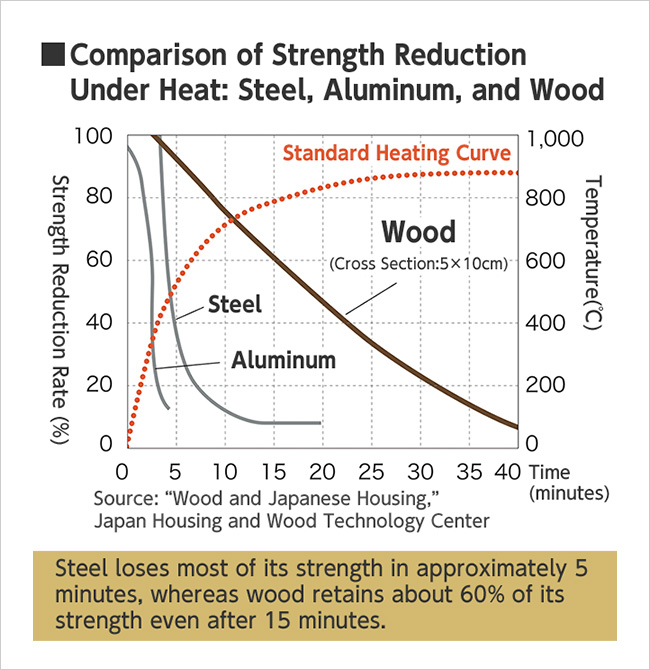
However, fire resistance tests have shown that wood loses its structural strength more slowly than materials such as steel.
When wood has sufficient thickness, it forms a charred surface layer as it burns, creating a protective barrier that prevents flames from penetrating deeper into the material.
Because its strength deteriorates more slowly than steel, wooden structures are less likely to collapse rapidly during a fire, allowing the structural frame to remain intact.
By contrast, steel rapidly loses strength and deforms when exposed to fire-level temperatures exceeding 800°C.
Wood Is Stronger and Longer-Lasting Than Concrete and Steel
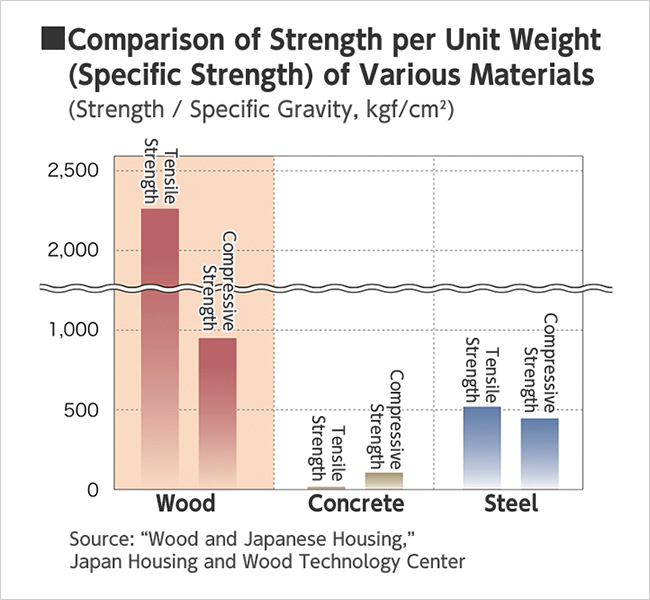
When tensile strength is compared by weight, wood is four times stronger than steel and twice as strong as concrete.
While the strength of concrete and steel changes over time due to aging, wood—when kept sufficiently dry—can last for an exceptionally long period, as demonstrated by Horyu-ji Temple, the world’s oldest surviving wooden structure.
Overcoming the Weaknesses of Wood
Using High-Durability JAS-Certified Materials
Conventional wood materials often had issues such as high moisture content, warping, twisting, and variations in quality over time, which posed challenges when used as structural components.
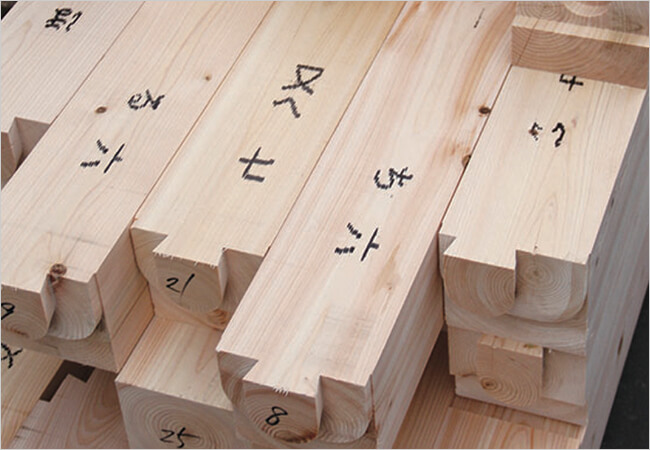
To address these issues, we use JAS-certified solid wood and engineered wood that are thoroughly dried, uniform in quality, and resistant to warping.
By adopting these materials for columns and beams, we achieve wooden homes that are stronger, more comfortable, and capable of maintaining consistent strength and performance over long periods.

Enhancing the Potential of Wood
“Pre-Cut Processing”
We utilize pre-cut processing, which enables millimeter-level precision through computer-controlled machining.
By combining this process with thoroughly dried JAS-certified materials, we ensure stable quality with minimal changes even after pre-cut processing.
In addition, engineered wood has a low moisture content, making it highly resistant to decay fungi and termites, further enhancing durability.
Wood Regulates Humidity
A Natural Air Conditioner
Even after being processed, wood retains its natural humidity-regulating properties.
In wooden homes, wood absorbs moisture when humidity is high and releases it when the air becomes dry, naturally regulating indoor humidity levels.
In other words, wood functions like a natural air conditioner.
A single standard timber beam can hold the equivalent moisture of approximately 2.5 beer bottles, automatically regulating humidity with about 0.5 to 1 bottle’s worth of moisture.
Wood Is a Natural Insulation Material
Because wood contains a large amount of air that does not easily transfer heat, it offers superior insulation compared to concrete and steel.
As seen in the use of wood for pot handles, its thermal conductivity is extremely low.
As a result, wooden homes are less affected by outdoor temperatures, staying cool in summer and warm in winter.

Wood Produces Less CO₂
An Environmentally Friendly Material
Wood absorbs carbon dioxide through photosynthesis and converts it into oxygen.
Even after being processed into building material, it continues to store the absorbed CO₂ until it is eventually burned.
Additionally, wood can be used as a building material with minimal processing after harvesting.
Compared to steel and aluminum products—which require large amounts of fuel, water, and emit CO₂ and sulfur dioxide—wood is far more environmentally friendly.
Using wooden homes over long periods helps reduce overall CO₂ emissions.
Wood Is Also Gentle on People
Natural wood is a material that is gentle on the people who live with it.
In addition to its warm appearance, wood offers insulation, humidity control, and soundproofing effects.
Recently, the forest-bathing benefits derived from phytoncides—aromatic compounds released by wood—have also gained attention, highlighting the many ways wood contributes to comfort and well-being.